
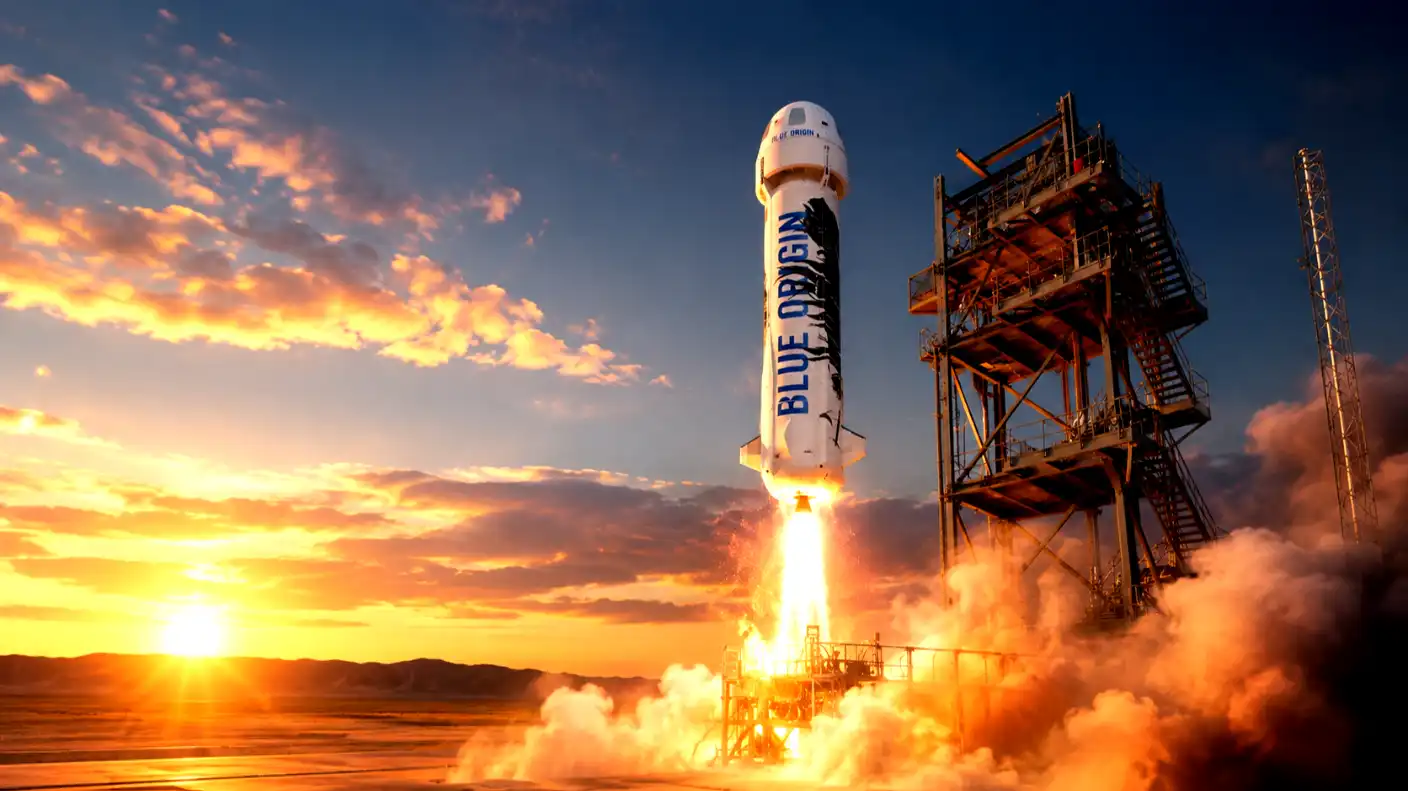
Blue Origin, the aerospace company founded by billionaire Jeff Bezos, suffered a catastrophic setback this week after its massive New Glenn rocket exploded during a ground testing procedure at Cape Canaveral, Florida. The explosion occurred while ground crews performed a cryogenic loading test, a standard but inherently risky procedure where engineers fill the rocket’s tanks with super-chilled liquid oxygen and liquid natural gas to verify the integrity of the fuel systems. While no personnel were injured, the blast destroyed the rocket’s first stage and caused significant damage to the company’s expensive launch pad infrastructure.
The loss of the vehicle marks a severe blow to Blue Origin’s ambitious launch schedule. The company had only recently secured its first formal launch license from the Federal Aviation Administration (FAA), and teams were working around the clock to prepare the heavy-lift rocket for its maiden voyage later this summer. That timeline now looks entirely unrealistic as investigators from the FAA and Blue Origin begin the long process of determining exactly what caused the pressure anomaly that led to the breach of the rocket’s primary fuel tanks.
This explosion brings the total financial toll of the New Glenn program into sharp focus. Over the last ten years, Blue Origin has poured more than $1 billion into the design, testing, and construction of this heavy-lift launch system. Every delay caused by a hardware failure adds millions of dollars in unexpected overhead, forcing the company to rethink its strategy for competing with established players like SpaceX. For a firm that has historically moved much slower than its rivals, a multi-month repair process at the launch pad could cause the company to lose valuable commercial contracts.
Technical observers note that the first stage of the New Glenn rocket uses seven BE-4 engines, which are designed to produce a staggering 3.8 million pounds of thrust. Integrating these powerful engines into a single, cohesive launch vehicle is an incredibly complex engineering feat. The explosion likely originated within the interface between the rocket’s internal plumbing and the ground support equipment used to fuel it. If the failure stems from a design flaw in the fueling system or the engine integration, Blue Origin may need to redesign portions of its ground infrastructure across its multiple launch sites to prevent a repeat failure.
The recovery effort at Cape Canaveral will be a slow, grueling process. Before a rocket can ever sit on that pad again, cleanup crews must verify the structural integrity of the massive launch tower and the surrounding flame trench. Heat from the fire may have warped steel reinforcements or damaged the sensitive electrical sensors embedded deep in the concrete foundation. Repairing these systems requires surgical precision and a complete re-certification from government safety officials. Industry standards suggest that restoring a site after a pad-level explosion usually takes several months, potentially pushing the debut flight of New Glenn well into 2027.
Despite the fire, Blue Origin remains committed to its long-term aerospace vision. The company views New Glenn as the essential vehicle for fulfilling its massive, multi-billion-dollar contracts with NASA and other commercial partners. Specifically, the rocket is slated to serve as a key component for the Artemis moon missions, where it is expected to carry heavy landers and cargo modules to lunar orbit. A reliable heavy-lift vehicle is the only way for Blue Origin to compete for these high-value government payloads, making the return to flight an absolute business necessity.
The incident serves as a harsh reminder of the difficulty inherent in rocket science. Even with top-tier engineering talent and massive financial backing, the extreme forces required to reach orbit leave little room for error. A tiny fault in a valve or a slight fluctuation in tank pressure can lead to a total loss of the vehicle in seconds. While the space industry has seen massive improvements in reusability and launch frequency, the “ground test” phase remains the most unpredictable hurdle for any new heavy-lift rocket.
For now, the focus shifts to the official investigation. The FAA will likely demand a full report on the telemetry data captured in the seconds leading up to the explosion. Investigators will look for clues in the flight computer logs and the pressure sensors located throughout the first stage. Once the company understands why the tanks failed, it will need to implement design changes and undergo a new round of rigorous safety testing.
This failure also places immense pressure on the company’s internal morale. Blue Origin has faced criticism in recent years for its slow pace compared to other aerospace companies. A public explosion on a launch pad can deflate the excitement of the engineering teams who have spent years waiting to see their work soar. However, the company has successfully weathered difficult setbacks before and maintains a strong financial cushion to see the program through to completion.
Ultimately, the global aerospace market is evolving into an environment where only the most reliable launch providers will succeed. The competition for launch windows and qualified engineering talent is at an all-time high, and every failure provides a strategic opening for competitors to capture market share. Blue Origin must now prove that its New Glenn architecture is robust enough to survive this fire. If the team can pinpoint the error and implement a fix, the program may yet achieve its goal of becoming the backbone of the next generation of American space flight.