
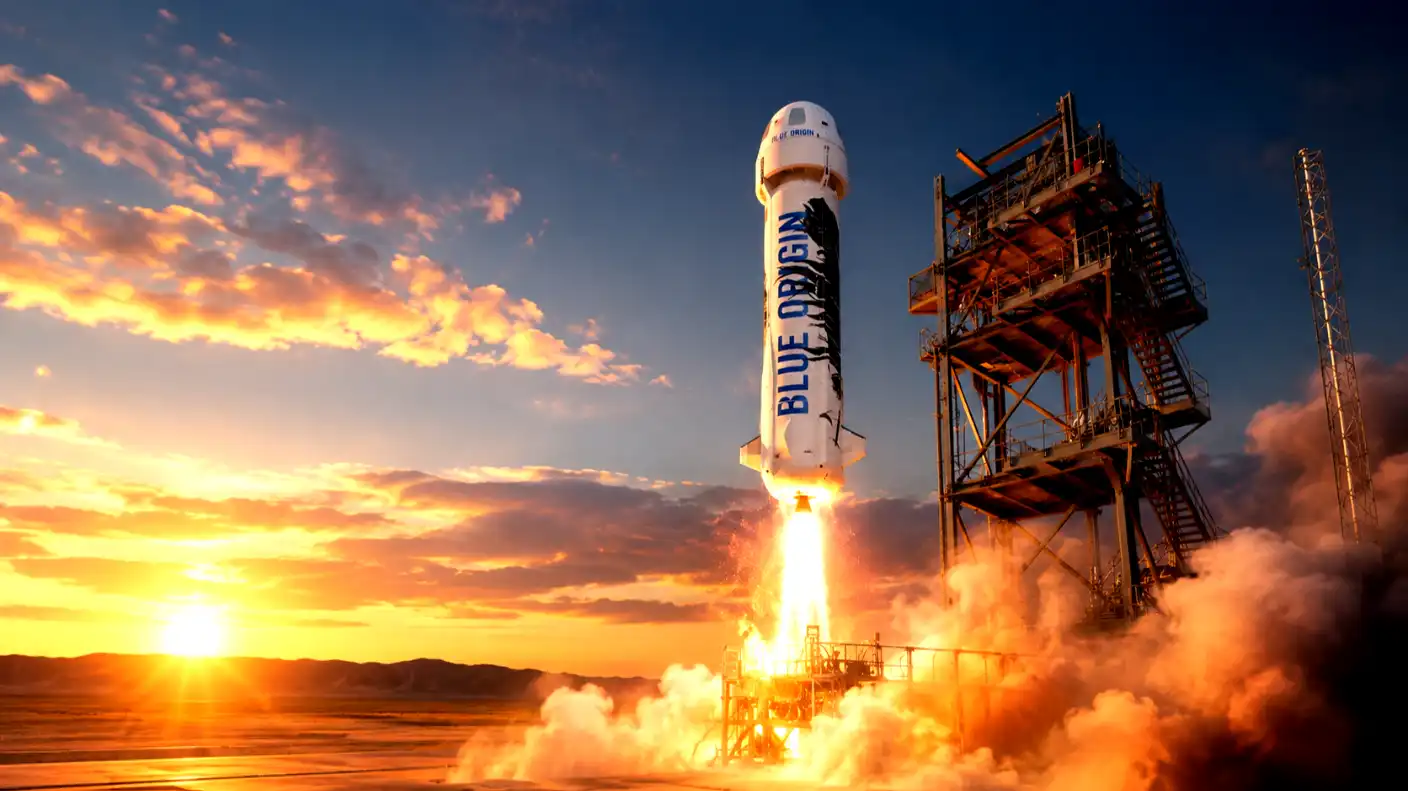
Blue Origin suffered a major setback this week after an explosion occurred during a routine ground test of its New Glenn rocket at Cape Canaveral, Florida. The incident, which took place on the launch pad, resulted in significant damage to the company’s ground support infrastructure. While the company confirmed that no personnel were injured during the event, the loss of hardware represents a difficult moment for Jeff Bezos’ aerospace firm, which has spent years attempting to move from a small-scale space tourism business to a heavy-lift commercial launch provider.
The explosion reportedly occurred during a cryogenic propellant loading test. Engineers were filling the rocket’s tanks with super-chilled liquid oxygen and liquid natural gas to verify the integrity of the seals and plumbing systems. This process is a standard but dangerous part of pre-flight preparation. Investigators currently believe a pressure anomaly in the rocket’s first stage triggered the catastrophic failure, leading to a rapid release of fuel and a subsequent fire that consumed much of the testing equipment surrounding the vehicle.
This failure deals a heavy blow to Blue Origin’s aggressive timeline. The company recently celebrated receiving its first formal launch license from the Federal Aviation Administration, and teams were already preparing for an orbital debut later this summer. Now, those plans are effectively on hold. The investigation team must perform a root-cause analysis to determine why the tank failed under pressure. Until the FAA approves the investigation’s findings and the company repairs the damaged launch pad, New Glenn will remain grounded.
The financial implications of this disaster are substantial. Blue Origin has poured more than $1 billion into the development of the New Glenn program over the last decade. Every delay adds millions of dollars in overhead and slows down the revenue-generating potential of the rocket. Because the space industry is a race for market share, every week spent cleaning up a launch pad disaster gives competitors like SpaceX more time to solidify their dominance and secure lucrative commercial and government contracts.
Technical observers note that the BE-4 engine, which powers the first stage of the New Glenn, has faced development challenges in the past. While these engines were previously tested on other platforms, integrating seven of them into a single heavy-lift rocket creates a complex web of plumbing and software controls. The explosion likely originated in the ground support interface, where the rocket connects to the massive fuel tanks located on the launch pad. If the failure stems from a design flaw in the fueling system, Blue Origin may need to redesign portions of its ground infrastructure across multiple launch sites.
The recovery process for a launch pad fire is never quick. Cleanup crews must first verify the structural stability of the launch tower and the surrounding flame trench. Any heat damage to the steel reinforcement or the complex plumbing systems underneath the pad must be repaired with surgical precision to ensure the safety of future flights. Industry standards suggest that even with a rapid response, restoring the site could take several months, potentially pushing the maiden flight of New Glenn into 2027.
Despite the setback, Blue Origin remains committed to its long-term goals. The company views New Glenn as the backbone of its plan to compete for high-value government payloads, including NASA’s Artemis lunar missions. Blue Origin has already won multi-billion dollar contracts to build lunar landers, and those missions depend entirely on the heavy-lift capacity that only New Glenn can provide. If the rocket cannot reach orbit reliably, the company’s ability to fulfill these national security and scientific obligations will remain in doubt.
Space enthusiasts often highlight the difficulty of rocket science, and this event serves as a stark reminder of that reality. Even established firms with massive resources can experience catastrophic ground failures. For a company that has largely stayed out of the public spotlight while refining its engineering, this public explosion creates a new pressure to perform. The next test window will be under intense scrutiny from both the FAA and the aerospace community, who will want to see that the company has fixed the underlying issues.
The broader space industry is currently undergoing a massive transformation. As more firms attempt to build heavy-lift rockets, the competition for launch windows and qualified engineering talent is at an all-time high. A 1.5% success rate improvement in the industry’s overall launch cadence would be worth billions in global trade, but disasters like this show that we are still in the “experimental” era of reusable rockets. Every failure, while painful, provides the data needed to make the next generation of launch vehicles safer and more reliable.
For now, the team in Florida is focused on damage control. They must satisfy regulators, retain the confidence of their commercial satellite customers, and prove that the New Glenn architecture remains sound. Jeff Bezos has always taken a “long-term” approach to his aerospace ventures, often saying that he is willing to accept temporary setbacks to achieve permanent results. The road to the stars is never smooth, and today, Blue Origin is learning that lesson the hard way.