
In the relentless, high-velocity world of the 21st-century digital economy, a single, unassailable truth has emerged: every company is now a software company. The ability to create, deploy, and rapidly iterate on custom software applications is no longer a competitive advantage; it is the fundamental, table-stakes requirement for survival. Yet this universal demand has collided with a harsh, persistent reality: a severe, ever-widening global shortage of skilled, professional software developers. For decades, this “developer gap” has been a massive and frustrating bottleneck, a chasm between the endless digital ambitions of the business and the limited capacity of the IT department to deliver.
But a powerful and profoundly disruptive new movement is now rising to bridge this chasm. This is the era of low-code/no-code (LCNC) software platforms. This is not just a new set of tools; it is a full-scale democratization of the act of creation. These platforms are a revolutionary new layer of abstraction, a visual, intuitive, and “drag-and-drop” paradigm that empowers a new and vast army of creators—the business analysts, the marketing operations managers, the HR specialists, the people who are closest to the business problem—to build their own applications, automate their own workflows, and solve their own problems, without having to write a single line of traditional code. This is the dawn of the “citizen developer,” a revolution that is not just changing who can build software but is fundamentally reshaping the speed, agility, and very nature of digital transformation itself.
The Bottleneck of the Past: The Inherent Friction of Traditional Software Development
To understand the immense and urgent appeal of the low-code revolution, we must first diagnose the deep-seated problems and the inherent friction of the traditional, code-intensive software development model.
For a business user with a pressing problem, the traditional path to a software solution has been a long, expensive, and often-frustrating journey.
The Overburdened IT Department: A “Tyranny of the Backlog”
In most organizations, the central IT and professional development teams are perpetually overwhelmed. They are responsible for maintaining mission-critical, enterprise-wide systems and are facing a massive, ever-growing backlog of requests from the business.
- The “Tyranny of the Backlog”: A request from a business department for a new, simple application or a departmental workflow automation could end up sitting in the IT backlog for months or even years, waiting to be prioritized against other, larger strategic initiatives.
- The 80/20 Problem: A large share of business requests are for relatively simple, “long-tail” applications—a new data entry form, a simple approval workflow, a departmental dashboard. While these are not complex from a technical perspective, they still require the time and attention of a scarce and expensive professional developer, making the ROI difficult to justify.
The High Cost and Long Timelines of Custom Development
Building a custom application from scratch with traditional code is an incredibly expensive and time-consuming endeavor. It requires a specialized team of front-end developers, back-end developers, and DevOps engineers, and a project can take many months or even years to complete. For most departmental needs, the cost and the timeline of a full custom development project are simply a non-starter.
The Communication Chasm: The “Lost in Translation” Problem
The traditional development process is often plagued by a deep communication chasm between the business user who has the problem and the professional developer who is building the solution.
- The “Lost in Translation” Problem: A business user describes their needs in the business’s language. This is then translated into a formal requirements document, which the developer then turns into code. At each step of this “game of telephone,” the original intent can be lost or misinterpreted, often resulting in a final product that does not actually solve the user’s real problem.
The Rise of “Shadow IT”
Faced with an unresponsive IT department, frustrated and enterprising business users have often taken matters into their own hands, creating a phenomenon known as “shadow IT.” This involves using a patchwork of unsanctioned, consumer-grade tools—such as complex Excel spreadsheets with macros, Google Forms, and personal Smartsheet accounts—to build makeshift solutions. While this solves the immediate problem, it creates a massive and hidden risk for the organization in terms of security, compliance, and data governance.
The Low-Code/No-Code Paradigm: Deconstructing the Democratization of Development
The rise of the low-code/no-code (LCNC) platform is a direct and powerful response to every one of these challenges. It is a new, far more accessible way to build software, designed to empower a much broader set of creators.
While the terms are often used together, it is useful to understand the subtle distinction between “low-code” and “no-code.”
No-Code: The Realm of the True Citizen Developer
No-code platforms are, as the name suggests, designed for users with absolutely no prior coding experience. They are the ultimate “citizen developer” tools.
- The Core Philosophy: No-code is about providing a purely visual, declarative, “what you see is what you get” (WYSIWYG) development experience. The user builds an application by dragging and dropping pre-built components and by configuring business logic through simple, Excel-like formulas or dropdown menus. There is no “escape hatch” to write traditional code.
- The Target Audience: The primary audience for no-code is the business user, the domain expert who understands the business process intimately but has no desire to become a programmer.
- The Use Cases: No-code is perfect for building simple yet highly valuable applications such as data collection forms, simple approval workflows, departmental project management tools, and internal resource directories.
- The Key Players: A vibrant ecosystem of no-code platforms has emerged, including Airtable (a powerful database-meets-spreadsheet tool), Smartsheet (for collaborative work management), and a host of workflow automation tools.
Low-Code: Bridging the Gap Between the Business and IT
Low-code platforms take this visual, model-driven approach and add a powerful “escape hatch.” While the majority of an application can be built using the same drag-and-drop techniques as a no-code platform, a low-code platform allows developers to “drop down” into traditional code to write a custom component, build a complex integration, or implement a piece of highly specialized business logic.
- The Core Philosophy: Low-code is about providing a “best of both worlds” approach. It is about dramatically accelerating the development process for professional developers and about providing a “higher ceiling” of capability for more technical business users.
- The Target Audience: The low-code audience spans a spectrum. It includes the “power user” or tech-savvy business analyst who is willing to learn a bit of scripting, as well as the professional developer who wants to use the platform to build mission-critical, enterprise-grade applications much faster.
- The Use Cases: Low-code platforms can be used to build a much wider and more complex range of applications than no-code, from modernizing a legacy enterprise system to building a new, customer-facing mobile app.
- The Key Players: The low-code market is massive, with powerful, enterprise-grade platforms from vendors such as Microsoft (Power Platform), Salesforce (Salesforce Platform), ServiceNow, OutSystems, and Mendix.
The Core Components of an LCNC Platform
While the specific features vary, most modern LCNC platforms are built on a common set of core components.
This is the integrated toolkit that enables rapid application development.
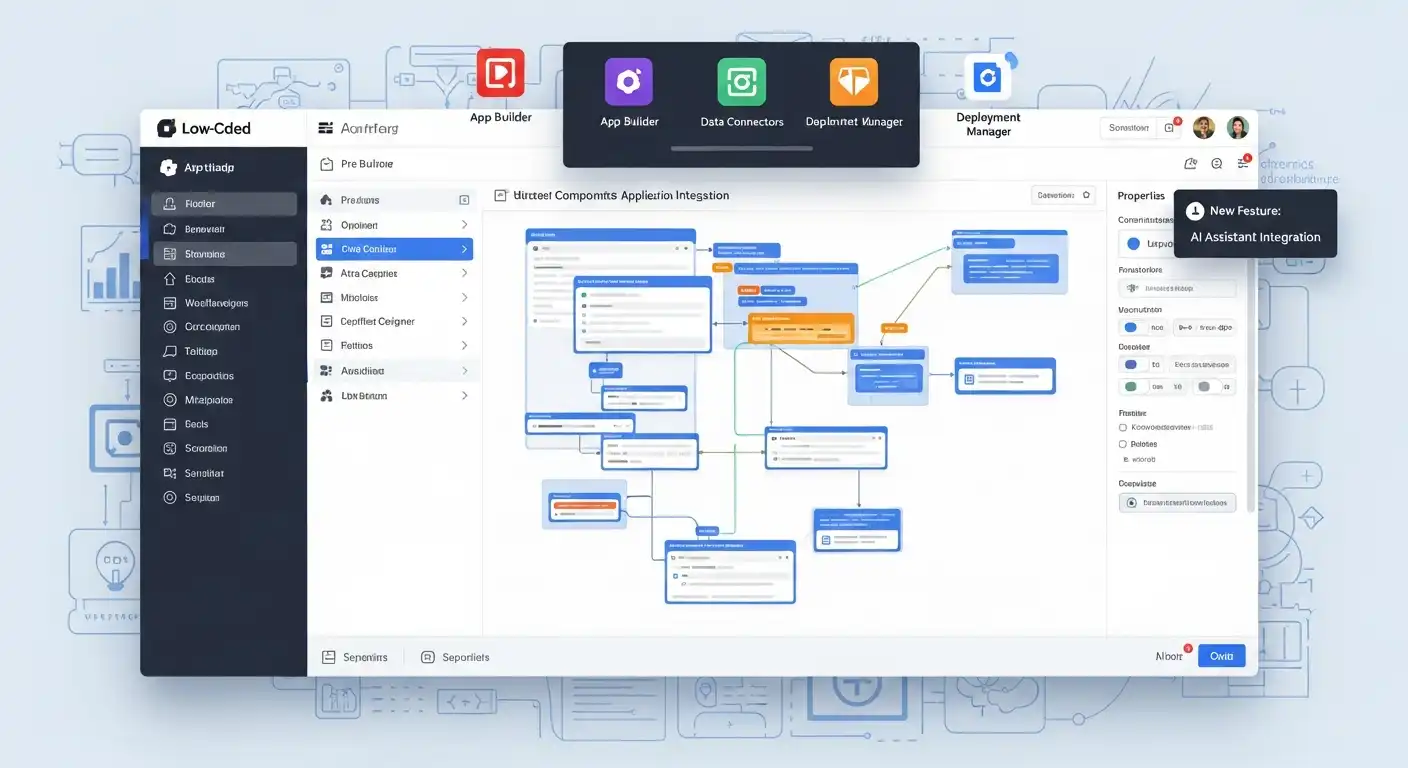
- The Visual UI Builder: A drag-and-drop, WYSIWYG editor for designing the application’s user interface for both web and mobile, without having to write HTML, CSS, or JavaScript.
- The Data Modeling and Management Layer: An integrated, visual database or a tool for easily modeling the data that the application will use.
- The Visual Workflow and Business Logic Designer: A graphical, flowchart-like interface for defining the application’s business logic and orchestrating its workflows.
- The Pre-built Connectors and Integration Layer: A library of pre-built connectors that make it easy to integrate the application with hundreds of other popular SaaS applications and data sources (like Salesforce, SharePoint, or a SQL database).
- The “One-Click” Deployment and Hosting: The platform handles the complexity of the underlying infrastructure, allowing users to deploy their new application to the cloud with a single click.
The Transformative Impact: The Pervasive Role of Low-Code in the Modern Enterprise
The adoption of LCNC platforms is not just about building a few small departmental apps. It is a strategic shift that is delivering a profound, wide-ranging set of benefits, fundamentally changing the relationship between the business and the IT department, and accelerating the overall pace of digital transformation.
A Quantum Leap in Agility and Speed-to-Market
This is the single biggest and most immediate benefit. LCNC platforms can reduce the time to build and deploy a new application by 10x or more.
- From Months to Days: An application that would have taken a team of professional developers six months to build with traditional code can often be built by a citizen developer or a small low-code team in a matter of days or weeks.
- The Power of Iteration: This incredible speed also enables a much more agile and iterative approach to development. A business user can have an idea for an app in the morning, build a minimum viable product (MVP) in the afternoon, gather feedback from colleagues, and then iterate on it in real time. This tight feedback loop between the problem owner and the solution builder is the very essence of agile development.
The Democratization of Innovation and the Empowerment of the Citizen Developer
LCNC platforms are a powerful force for democratization. They are breaking down the old IT department monopoly on software creation and empowering a much broader, more diverse set of people to become “creators.”
- Unlocking the “Long Tail” of Business Needs: LCNC is the perfect solution for the massive, underserved “long tail” of departmental and individual business needs that would never have been high enough on the priority list to justify a full custom development project.
- The Domain Expert as the Developer: The most powerful aspect of the citizen developer revolution is that it puts the power of creation directly into the hands of the person who understands the business problem the best. There is no “lost in translation” problem. The marketing operations manager who is building their own workflow automation knows exactly what the process needs to be.
Bridging the Chasm: A New, Collaborative Partnership Between Business and IT
Far from making the IT department obsolete, the rise of low-code is actually forging a new, more strategic, and collaborative relationship between the business and IT.
In a mature low-code organization, IT’s role shifts from “gatekeeper” to “enabler.”
- From “No” to “Yes, and Here’s How”: Instead of being the “department of no,” the IT department’s role is to select, govern, and manage the enterprise-wide LCNC platforms. They provide a secure, compliant “sandbox” for citizen developers to build in.
- The Center of Excellence (CoE) Model: The most successful organizations are creating a formal Low-Code Center of Excellence (CoE). This is a centralized team that is responsible for:
- Governance and Guardrails: Setting the “rules of the road” for the use of the platform, ensuring that the apps being built are secure, compliant, and well-governed.
- Enablement and Training: Providing the training, the best practices, and the support that the citizen developers need to be successful.
- Building the Reusable Components: Professional developers in the CoE can use their great technical skills to build more complex, reusable components and API integrations that citizen developers can use as simple, “drag-and-drop” building blocks.
Eradicating “Shadow IT.”
By providing a sanctioned, secure, and governed platform for business users to build their own solutions, LCNC is the ultimate solution to the problem of “shadow IT.” It brings all this hidden, risky development out of the shadows and into a managed, visible environment.
Accelerating the Modernization of Legacy Systems
Low-code platforms are emerging as a powerful, pragmatic tool for modernizing the clunky, on-premises legacy systems that are a major source of technical debt for many large enterprises.
- The “Strangler Fig” Pattern: Instead of a massive, high-risk “rip and replace” project, a company can use a low-code platform to incrementally “strangle” the old legacy system. They can build a new, modern, user-friendly front-end on the low-code platform that interacts with the legacy system via APIs. Over time, more and more of the old system’s functionality can be rebuilt on the new platform, until the old system can finally be decommissioned.
The Low-Code/No-Code Landscape: A Guide to the Key Platforms and Players
The LCNC market is a vast, dynamic, and sometimes confusing landscape, with a large number of vendors, each with a different focus and set of strengths.
The market can be broadly segmented into a few key categories.
The Enterprise-Grade, High-Control Low-Code Platforms
These are the “heavyweight” platforms designed for building mission-critical, enterprise-grade, and often complex applications. They are primarily targeted at professional developers and dedicated IT teams, but with a strong focus on dramatically accelerating their productivity.
- The Key Players: OutSystems and Mendix are the two established leaders in this category. They provide a comprehensive, end-to-end platform for building, deploying, and managing complex web and mobile applications, with a high degree of control over architecture and security.
The SaaS Platform Extensions: The “In-Ecosystem” Powerhouses
These are the LCNC platforms provided by the major SaaS and cloud giants. Their primary strength is their deep, native integration with their parent company’s massive ecosystem of data and services.
- The Microsoft Power Platform (Power Apps, Power Automate): This is a massive and rapidly growing force in the market. The Power Platform is a suite of LCNC tools that is deeply integrated with Microsoft 365, Dynamics 365, and Azure. Power Apps allows users to build custom apps, and Power Automate (formerly Microsoft Flow) allows them to build complex workflow automations, all with deep, seamless connections to the data already in their SharePoint lists, Excel files, and Dynamics CRM.
- The Salesforce Platform (and the recent acquisition of MuleSoft): Salesforce has had a powerful low-code platform at its core for years, enabling a large ecosystem of “Salesforce Admins” (essentially citizen developers) to customize and extend their CRM. With its recent acquisitions of MuleSoft (for API integration) and Tableau (for analytics), and its own workflow automation tools, the Salesforce Platform is a comprehensive LCNC powerhouse.
- ServiceNow: ServiceNow started as an IT Service Management (ITSM) tool but has evolved into a powerful, enterprise-wide “platform of platforms” for automating and managing all enterprise workflows, from IT and HR to customer service.
The No-Code “Democratizers.”
These platforms are focused squarely on the true “no-code” vision, empowering non-technical business users to build powerful applications and workflows without writing a single line of code.
- The “Spreadsheet-Meets-Database” Hybrids: Airtable is the breakout star in this category. It provides a familiar, spreadsheet-like interface, but with the power of a relational database on the back end. This has made it an incredibly popular and flexible tool for a huge range of use cases, from project management and CRM to content calendars.
- The Workflow Automation Specialists: This is the world of “iPaaS for the business user.” Platforms like Zapier and Make (formerly Integromat) provide a simple, visual interface that lets users create “zaps” or “scenarios” to connect their SaaS applications and automate workflows. (e.g., “When a new lead is created in my HubSpot, automatically create a new row in my Google Sheet and send a notification to my Slack channel.”)
- The No-Code App Builders: Platforms like Bubble and Adalo focus on enabling non-technical entrepreneurs and creators to build and launch fully-featured, customer-facing web and mobile applications without code.
The Road to Adoption: The Strategic Playbook for a Successful LCNC Initiative
While the promise of LCNC is immense, a successful, enterprise-wide adoption is not as simple as just buying a new piece of software. It requires a deliberate, strategic, and human-centric approach.
A successful journey requires a partnership between the business and the IT department, built on a foundation of governance and enablement.
The “Center of Excellence” (CoE) is the Foundation
As we have seen, the creation of a formal Low-Code Center of Excellence (CoE) is the single most critical success factor for scaling an LCNC initiative in a large organization.
The CoE is the “enabling function” that makes the citizen developer revolution both safe and productive.
The Governance Framework: The “Guardrails” for Innovation
The biggest fear of the IT department is that the rise of the citizen developer will lead to a new, even more chaotic form of “shadow IT,” with a proliferation of insecure, unsupported, and siloed applications.
A strong governance framework is the answer to this fear. It is not about saying “no,” but about providing a set of safe “guardrails” within which the citizen developers can innovate.
- The Key Governance Questions: The CoE must establish clear policies for:
- Which platforms are sanctioned?
- What kind of data can be accessed?
- What are the security and compliance requirements for a new app?
- What is the process for promoting an app from “personal productivity” to a “departmental” or even an “enterprise-grade” solution?
The Enablement Program: Cultivating the Citizen Developer
The other key role of the CoE is to cultivate and support the community of citizen developers actively.
- Training and Certification: The CoE should provide a range of training resources, from online courses to in-person workshops, to teach business users how to use the sanctioned platforms effectively and responsibly.
- Building a Community of Practice: The CoE can foster a community where citizen developers across the company can share their creations, ask for help, and learn from each other.
- Providing the “Pro-Code” Support: The CoE should be the home for professional developers who can provide “pro-code” support for citizen developers, building complex, reusable components and API integrations beyond the reach of a no-code tool.
The Future is Low-Code: The Next Wave of the Revolution
The low-code revolution is still in its early innings. The platforms are becoming more powerful, more intelligent, and more deeply woven into the fabric of the enterprise.
Several key trends are shaping the future of this powerful movement.
The Deep Infusion of Generative AI
The most significant trend is the deep, pervasive integration of generative AI into LCNC platforms.
- From “Low-Code” to “Natural-Language-to-App”: The future of app development will be a conversation. A business user will be able to describe the application they want to build in plain, natural language, and the AI will automatically generate the first version of the app—the data model, the UI, and the workflows. The user will then be able to refine the app through a continuing conversation with the AI. Microsoft’s “Copilot” in its Power Platform is at the forefront of this trend.
- AI-Assisted Development: The AI will act as an intelligent copilot for the citizen developer, suggesting the next step in a workflow, identifying potential errors, and even automatically generating app documentation.
The Convergence of LCNC and Hyperautomation
The lines between the LCNC application development platforms and the broader “hyperautomation” platforms (which include RPA and BPM) will continue to blur. The major vendors are in a race to create a single, unified “intelligent automation” platform that provides a comprehensive toolkit for automating every process in the enterprise.
The Rise of the “Composable Enterprise”
The LCNC paradigm is a key enabler of the “composable enterprise.” In this vision, the business itself is seen as a collection of modular, interchangeable “packaged business capabilities” that can be rapidly assembled and re-assembled using low-code platforms and APIs to respond to new market opportunities.
Conclusion
The explosive rise of low-code and no-code software platforms represents a fundamental, irreversible shift in our relationship with software development. It is a powerful wave of democratization that is breaking down the old, artificial barriers between “the business” and “the technology” and empowering a new, far broader generation of digital creators. The tyranny of the IT backlog is giving way to a new era of business-led innovation, where the people closest to the problem are empowered to build their own solutions.
This is not a story about the end of the professional developer. It is a story about the elevation of their role—a shift from being the builders of simple forms and workflows to the architects of powerful, governed, and secure platforms upon which citizen developers can thrive. The journey to a fully realized, low-code-powered enterprise is a long one, requiring a deep partnership between business and IT and a profound cultural shift. But the destination is a business that is more agile, more innovative, and more deeply and authentically digital than ever before. The new language of business is no longer just English or Mandarin; it is the visual, intuitive, and powerful language of the low-code platform.