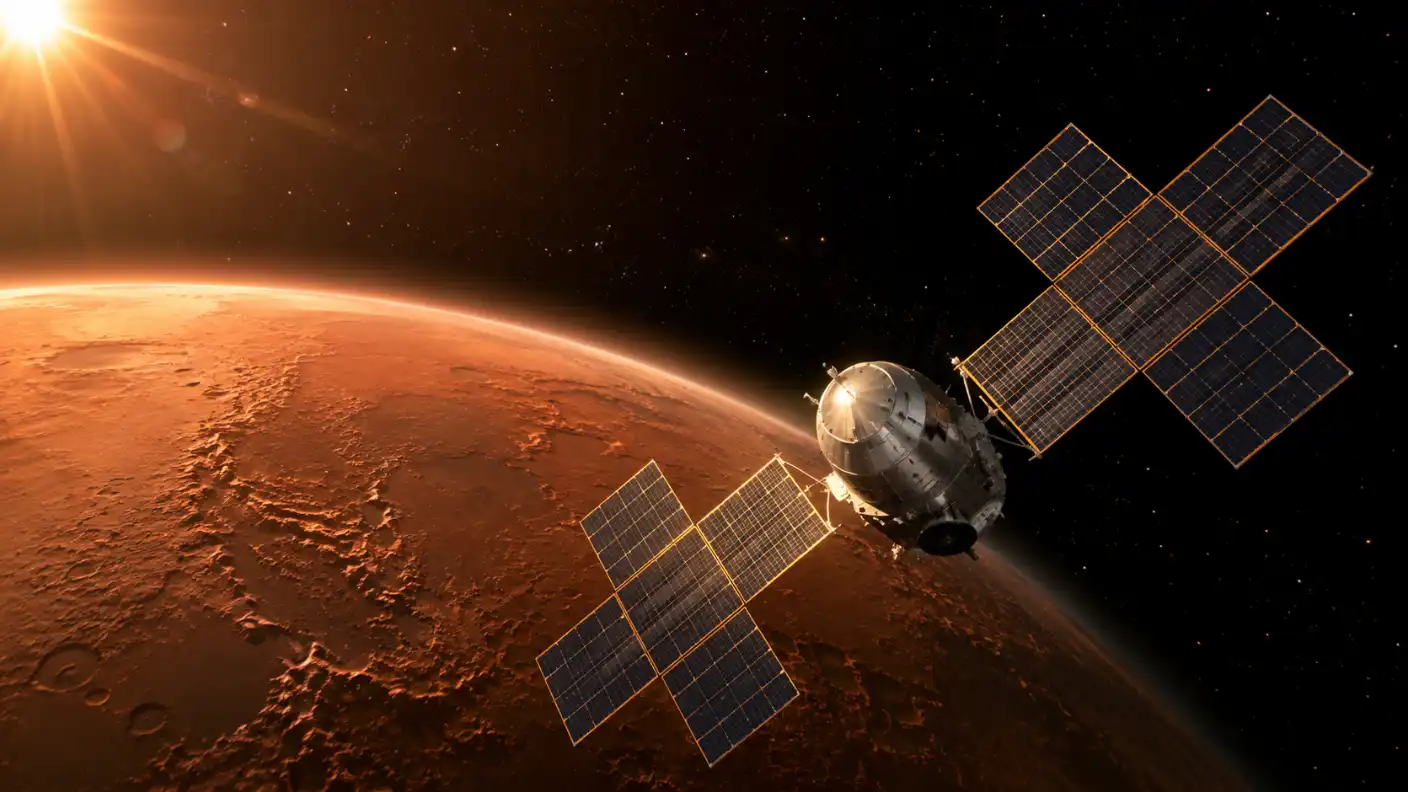
NASA just pulled off a tricky and essential space maneuver. The Psyche spacecraft recently zipped past Mars on its way to a giant, mysterious metal asteroid. During this trip, it got so close to the red planet that it was actually nearer to the surface than the planet’s own moons. This wasn’t a mistake or a close call; instead, engineers planned this move years in advance to help the ship reach its final home millions of miles away.
Space travel is incredibly expensive and difficult to manage. To stay within the mission’s $1.2 billion budget and keep fuel levels high, NASA used the planet’s gravity to their advantage. Think of it like a cosmic slingshot. By flying close to Mars, the ship stole a bit of the planet’s orbital energy to gain a massive speed boost. This move also changed the ship’s path so it now points exactly toward the asteroid it needs to study, saving a huge amount of onboard gas.
The numbers from the flyby are quite incredible. On May 15, around 3:30 PM, the ship reached its closest point at only 2,800 miles from the surface of Mars. To put that in perspective, the moon Phobos orbits the planet from 3,700 miles away. The other moon, Deimos, is much farther out at over 12,000 miles. Psyche was moving at a blistering 12,300 miles per hour as it passed by, taking advantage of the gravitational pull to whip itself into deep space.
The ship relies on a very modern engine system to get around. Instead of burning huge amounts of liquid fire like a regular rocket, it uses solar-electric ion thrusters. These engines use electricity from giant solar panels to zap xenon gas. This creates a gentle but constant push that eventually reaches high speeds. Even though it is slow to start, this system is much more efficient than regular fuel. Saving even 1.5% of this xenon gas during the Mars trip is a big win, as it means the ship can stay active for much longer once it reaches its destination.
During the approach to Mars, the onboard cameras stayed very busy. From the ship’s specific angle, Mars looked like a glowing, thin crescent in the dark. Dust and clouds in the Martian atmosphere reflected the sunlight, making the planet look bright and beautiful against the blackness of space. Over the next few weeks, the ship will send these high-resolution photos back to Earth. NASA uses a system called the Deep Space Network, which is a collection of giant antennas located in California, Spain, and Australia, to catch these weak signals from millions of miles away.
This trip is a marathon rather than a short sprint. Psyche left Earth in late 2023 on a massive 2.2-billion-mile journey. It still has three more years of quiet flying to do through the cold vacuum of space. If everything stays on track, it will reach the asteroid, also named 16 Psyche, in July 2029. Once it arrives, it won’t actually land on the surface. Instead, it will spend exactly two years orbiting the giant rock to map every inch of its metallic surface and figure out what it is made of.
Scientists believe 16 Psyche is one of the most interesting objects in our solar system. Most asteroids are made of stone or ice, but this one appears to be mostly metal. It looks like the leftover core of a planet that never finished growing. Billions of years ago, a massive collision might have stripped away the rocky outer layers of a young planet, leaving just the iron and nickel center exposed to space. This is something humans have never seen before.
This mission is a huge deal for our understanding of Earth. We live on top of a giant metal core, but we can never actually see it. The intense heat and crushing pressure at the center of our world make it impossible to dig that deep. By looking at 16 Psyche, we are essentially looking at a “naked” planetary core. It provides a unique window into the violent history of collisions and the gathering of matter that created rocky worlds like our own.
The project is part of a larger NASA push to explore the building blocks of our universe. The agency regularly invests over $1 billion into these discovery programs to answer the biggest questions about where we came from. The data from the Mars flyby confirms that the navigation is perfect and the ship’s hardware is in great health. Every instrument performed exactly as it should during the high-speed pass.
As the ship leaves Mars behind, it enters a long stretch of empty space before hitting the asteroid belt. The engineering team will now spend several months checking the instruments and making sure the solar panels are facing the sun. This Mars encounter was the last major milestone before the final arrival. Now, the world has to wait until 2029 to see what a world made of metal actually looks like.